Module 3 · THE FIRST TEN SECONDS · Lesson 1 of 2
What your body does before you decide
By the time you are thinking about it, your body has already been running for four seconds.
Lesson 5 of 12
Start here
Somebody bumps you hard in a hallway. Does not say anything, keeps walking.
Before you decide anything, something already happened in your chest and your hands. Name it.
Now hold onto the fact that it happened before you decided anything. That is the whole lesson.
What actually fires
Your body has a system for danger and it is faster than your thinking is. That is not a flaw, it is the design, and it has kept people alive for a very long time.
When it fires, a set of things happen and you do not vote on any of them.
Your heart rate goes up hard and fast. Your hearing narrows, which is why people genuinely do not hear instructions they were given. Your vision tunnels, so you stop seeing things at the edges. Your hands lose fine control, which is why people fumble a wallet they have taken out ten thousand times. And time distorts. Three seconds feels like ten, or ten feels like one.
You have felt every one of those. Read that list again and put a real moment next to each one.
The officer's body is doing it too
Here is the part that changes how you see the whole encounter.
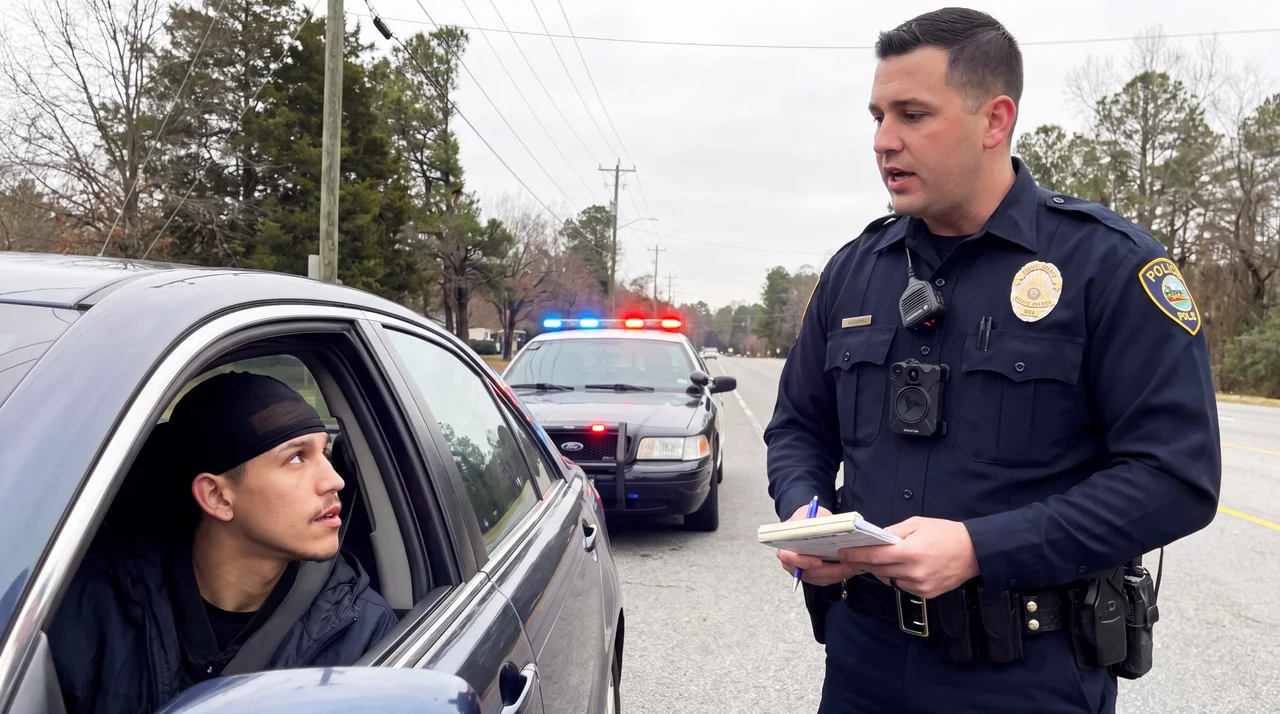
He is running the same system. Same narrowed hearing, same tunnel vision, same hands, same distorted clock. Trained, and still human.
Which means when two people are both in that state, small things get read as large things, and speed gets read as threat by both of them.
And it means one person slowing down changes the physics for both. That is not a nice idea. It is how the system works. A person who moves slowly and predictably gives the other person's body a reason to come down, and you are frequently the only one of the two in a position to start that.
The finding
Researchers in Chicago ran three randomized studies with thousands of young men. They were trying to find out what actually reduces the odds of somebody ending up arrested.
They did not find that it was self control. They did not find that it was emotional intelligence, or anger management, or knowing more.
What they found was speed. The young men who did better had learned to be less automatic. Same reactions, same feelings, more time between the feeling and the move.
In one of the studies, the young men who had been through the program spent seventy nine percent longer thinking before they acted. Arrests dropped by a third. Violent crime arrests dropped by close to half.
And the part worth underlining. The program never told them what to do. It taught them to notice when the automatic answer was going to be expensive, and to take the extra second. What they did with the second was theirs.
The automatic answer is usually right
This is why the lesson is not stop reacting.
Your automatic responses came from somewhere. Most of them are correct most of the time. If somebody moves at you fast on your block, reacting fast is not a defect, it is training that has worked.
The problem is that the same response runs in situations where it does not fit. The hallway bump. The teacher who says it wrong. The traffic stop.
So the skill is not shutting it down. The skill is recognizing which situation you are in, fast enough to choose. Some situations you go with it. Some you take the second.
That recognition is the whole thing, and it is learnable, and thousands of young men have already proved it is learnable.
The gap between what you feel and what you do is the only thing you actually own.
The workEight questions
Two of these nobody reads. They are marked.
Go back to the hallway. Write what happened in your body, in order, before you thought anything.
Where does it start for you?
- AChest and breathing
- BHands, they get tight or they shake
- CJaw and neck
- DStomach
What is the last thing that got you from zero to gone in under a second?
Pick two from the list in section one, narrowed hearing, tunnel vision, hands, or time distortion. Write a real moment for each where it happened to you.
You get pulled over. Which of these is most likely to be true of you in the first ten seconds?
- AI would not hear half of what he said
- BMy hands would not work right
- CIt would feel much longer than it was
- DI would go completely blank
Where did your automatic response get trained? What happened, and how old were you?
Name a situation where your automatic answer is exactly right and you would not change it.
Name a situation where your automatic answer has cost you. Be specific about what it cost.
DeeperThree reflections
Nobody reads these.
- 1
Write about the moment you learned to react the way you react. Somebody taught you, or something taught you. Write it out.
- 2
Write about a time you took the extra second and it changed the outcome. If you cannot find one, write about a time you wish you had.
- 3
Somebody you know reacts to everything and it is running their life. Write what you can see about them that they cannot see about themselves. Then read it back and ask whether any of it applies to you.
Before you go
Nobody in that Chicago study got better at not feeling things. They got better at the space between the feeling and the move, and that space turned out to be worth a third of all arrests.
That is a strange and hopeful finding, because it means the thing that helps is not a personality you do not have. It is a habit, and habits are built by repetition, which anybody can do.
Next lesson is the repetition.
Catch yourself once. One time this week, notice the reaction while it is happening and do not act for two seconds. It does not matter what you do after the two seconds. Write down what the situation was and what those two seconds felt like.