Module 1 · WHAT IS TRUE · Lesson 1 of 2
The numbers and the names
Before anybody tells you what to do, you should know what is actually happening.
Lesson 1 of 12
Start here
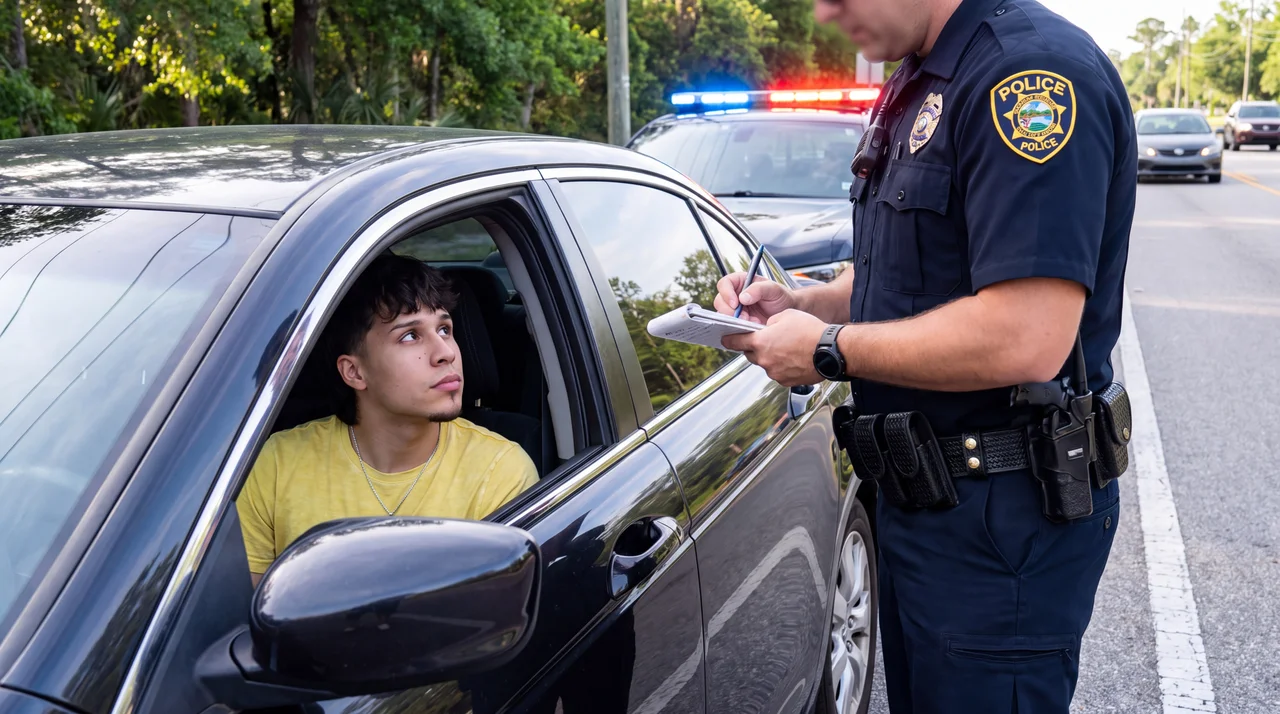
It is a Tuesday, about nine at night. You are driving your cousin's car back from dropping somebody off. Nothing in the car, nothing on you, you have a licence.
Blue lights.
Before you read another line, answer this in your head. What is the first thing you feel, and where do you feel it?
Hold that. The whole course comes back to it.
The number
About a thousand people a year are killed by police in this country.
Around a tenth of those happen at low level traffic stops. Tags, a light, a lane change. Not chases. Not shootouts. Somebody driving home.
A newspaper spent five years counting a narrower group: people killed by police who had no gun, no knife, and were not being chased for anything violent. They found more than four hundred. That is more than one a week for five years running.
Five officers were convicted out of those four hundred. Local governments paid out at least a hundred and twenty five million dollars settling the lawsuits.
You are allowed to sit with that for a second.
Who this happens to
Here is the part this course says once and then leaves alone.
Black drivers get searched at roughly one and a half to two times the rate white drivers do. That is not an opinion and it is not a feeling. It is what twenty million traffic stop records show when researchers count them.
And that is the last time this course frames anything that way.
Not because it stopped being true between this paragraph and the next one. Because you already knew it, and knowing it does not get you home. Eleven more lessons are about the things you can actually work with, and that is where the rest of this goes.
The names
Philando Castile. Thirty two, stopped in Minnesota in 2016 for a brake light. He was calm. Hands where the officer could see them. He told the officer he had a firearm and a permit for it before he was asked anything. He was shot in about seven seconds. The officer was acquitted.
Read that again, because it is the reason this course will never tell you that doing it right keeps you alive.
Tamir Rice. Twelve years old, in a park in Cleveland, playing with a toy gun. The car pulled up and he was shot in roughly two seconds. There is no behavior available in two seconds. Nothing anybody teaches you covers that.
Sandra Bland. Stopped in Texas for changing lanes without signalling. She was within her rights the entire time. It escalated over a cigarette. She was arrested and died in a cell three days later.
Tyre Nichols. Memphis, 2023, beaten to death after a traffic stop. The officers were Black. That case is in here on purpose, because if your whole theory is that this is about individual racist officers, Nichols does not fit, and a theory that does not fit reality will get you hurt. It was a special unit built to produce numbers. That is a different problem and it is a bigger one.
Officer created jeopardy
There is a term for something that shows up over and over in these cases, and it is worth knowing because it explains the ones that make no sense.
Officer created jeopardy. The officer's own tactics generate the danger the officer then reacts to. He steps in front of the car and then fires because the car is moving toward him. He reaches into the window and then the struggle he started becomes the reason for what follows.
The reason you need that phrase is this. When you hear about a case where the person did nothing and it still went bad, you do not have to conclude the world is random. It is not random. There is a name for it, people study it, and knowing the name is the difference between fear and understanding.
Knowing the numbers is not the same as being ready for the numbers.
The workEight questions
Two of these nobody reads. They are marked. Answer those ones honestly, because nobody is ever going to see them.
Have you been stopped? Write how many times, how old you were the first time, and where it happened.
Go back to the scenario at the top. Blue lights on a Tuesday night. What did you feel, and where in your body did you feel it?
You are seventeen, in the passenger seat, and your friend gets pulled over. Where do your hands go?
- AOn my lap, where he can see them
- BIn my pocket, on my phone
- CI had not thought about it
- DI would be turning around to see what is happening
Of the four names in section three, which one hits you hardest and why?
Do you believe there is anything you could do that would guarantee you get home? Answer honestly, not the answer you think is expected.
Somebody tells you Tyre Nichols proves this is not about race. What is the strongest thing you could say back?
- ANothing. They are wrong and I would not waste it
- BIt was a unit built to hit numbers, and that is a different problem than one racist officer
- CThey are partly right and it is more complicated than people say
- DI would not know what to say and that bothers me
Write, in your own words, what officer created jeopardy means. Do not copy the paragraph.
What do you want out of these twelve lessons? Be specific and be honest. If the honest answer is that somebody is making you do this, write that.
DeeperThree reflections
Nobody reads these. Write them anyway. The ones you would not say out loud are the ones doing the most work on you.
- 1
Write about the first time you were stopped, or the first time you watched somebody get stopped. All of it. What you were doing before, what happened, what you did for the rest of that day.
- 2
Somebody in your life has already given you a version of this talk. Write what they said. Then write what you thought while they were saying it.
- 3
Write what you would want somebody to know about you if you were the name in the news. Not the good version. The real one.
Before you go
You just read four names and a set of numbers, and if the honest reaction is anger, that is the accurate reaction. Nothing in the next eleven lessons asks you to stop being angry about it.
What they ask is narrower than that. There is a short list of things inside these encounters that you control, and there is a much longer list that you do not. Most people never separate the two, so they either think they control everything, which produces guilt, or they think they control nothing, which produces freezing. Both get people hurt.
The rest of this book is the short list.
Ask one adult in your life to tell you about a time they got stopped. Not what they think you should do. What actually happened to them. Write down one thing they said that you did not expect.