Module 6 · AFTER · Lesson 2 of 2
The six months
The stop is not the damage. It is the start of it.
Lesson 12 of 12
Start here
It was four months ago. A stop that went nowhere. No ticket, no arrest, twenty minutes on the side of a road.
Since then: you have been late to school more. You got into it with a teacher over nothing. You stopped going to the one thing you actually liked.
Nobody has connected those. Not even you.
What the research found
Researchers followed a large group of teenage boys over two years, checking in every six months.
Boys who were stopped by police reported more delinquent behavior six months later, twelve months later, and eighteen months later. That held even for boys who had never done anything before the stop.
And they found the pathway. It ran through psychological distress. The stop caused the distress, and the distress caused what came after.
The younger the boy was the first time, the stronger the whole effect.
More than forty percent of the boys in that study were stopped at least once in two years.
Read what that means. It is not that boys who get in trouble get stopped. It is that getting stopped makes trouble more likely afterward. The stop is not just something that happens to you. It does something to you.
What it looks like from the inside
Nobody experiences this as psychological distress. It shows up as ordinary things and that is why nobody catches it.
Anger that arrives late. Nothing at the time, then two weeks later you are furious at something small.
Not being able to be told anything. Every instruction from anybody starts landing as an order.
Pulling back. From school, from the program, from the people who ask you questions.
Sleep going wrong. Either you cannot or you do not want to be awake.
And the one that ends people. They already look at me like a criminal, so what is the point.
That last one is the pipeline. Not a metaphor. That specific thought, in that order, is the mechanism, and it feels like clarity when it arrives. It feels like you finally see how it really is.
It is not clarity. It is the distress talking, four months later, in a voice that sounds like your own.
Why naming it changes it
A pattern you cannot see runs you. A pattern you can see is a thing you can argue with.
That is the entire reason this lesson exists. Not to fix it. To let you catch it.
Four months from now, when you find yourself not going to something you used to go to, you now have a second thought available: is this the stop.
Sometimes the answer will be no. Sometimes you just do not want to go.
Sometimes the answer will be yes, and knowing it is the difference between a bad month and a bad two years.
The one thing that actually helps
Tell somebody.
Not because talking fixes it. Because carrying it alone is what lets it turn into the thing in section two.
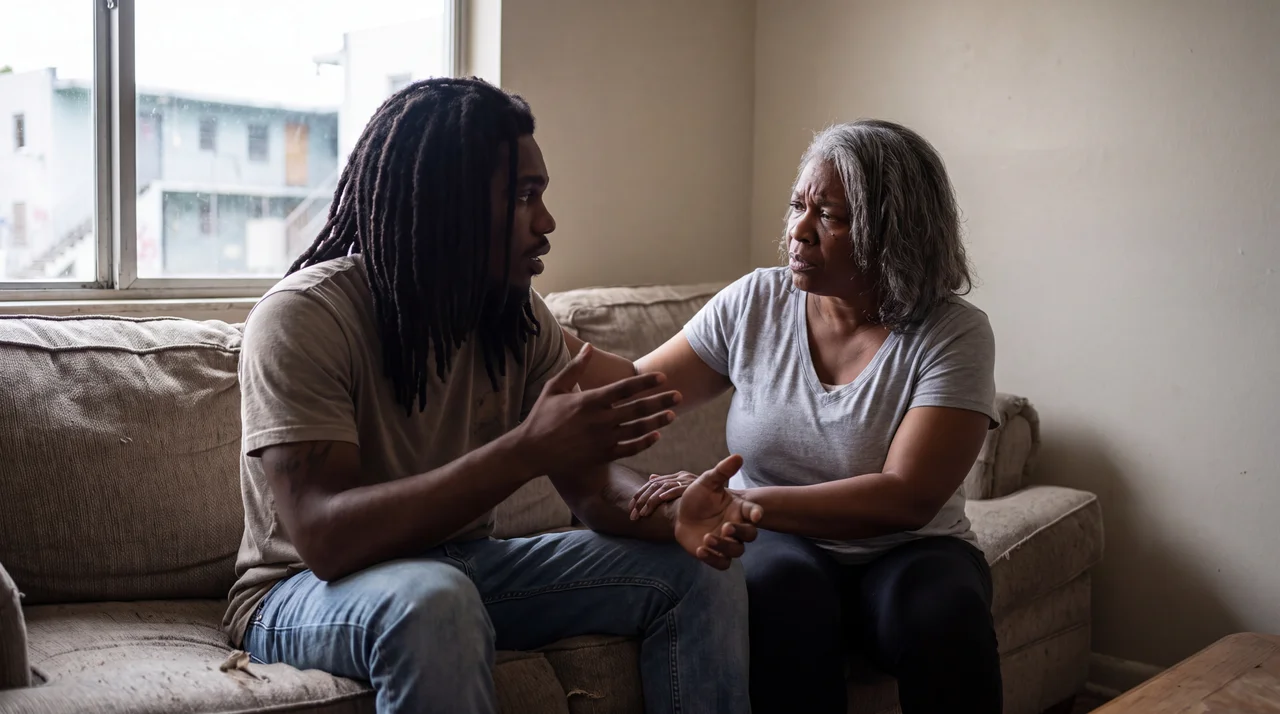
One person. A parent, a grandmother, a coach, a facilitator, a friend who has been through it. Somebody you can say I got stopped and I have been off ever since to.
And if it is heavy, that is not weakness. People carry things from encounters like this for years. Talking to somebody trained for it is a normal thing that people do and your facilitator has names and numbers.
One more. If you are the one somebody tells, do not fix it. Do not tell him what he should have done. Just let him say it. That is the whole job and almost nobody does it.
Do not let a twenty minute stop write the next two years.
The workEight questions
Two of these nobody reads. They are marked.
Explain the research finding in your own words, as if you were telling a friend.
Which of the five in section two is closest to you right now?
- AAnger showing up late
- BNot being able to be told anything
- CPulling back from things
- DSleep
Has something happened to you that you never told anybody? You do not have to write what. Just answer yes or no, to yourself.
Write the name of one person you could say I got stopped and I have been off ever since to.
They already look at me like a criminal, so what is the point. Have you ever thought that?
- AYes, and recently
- BYes, a while ago
- CNo, but I know people who have
- DYes, and I did not know it had a name until now
What did you stop doing this year that you used to care about? What happened right before you stopped.
You are the one somebody tells. Write what you say. Under twenty words.
Twelve lessons ago you wrote what you wanted out of this. Go back to Lesson 1.1, question eight, read it, and write what changed.
DeeperThree reflections
Nobody reads these.
- 1
Write about something that happened to you and the six months after it. Track what changed and be honest about what you did not connect at the time.
- 2
Write about somebody you watched go from one thing to another after something happened to them. What would you say to them now.
- 3
Write a page to yourself, dated one year from today. Name the person you intend to be by then and the two things that have to hold for that to be true. Your facilitator will hold it and send it back to you on that date.
Before you go
Twelve lessons ago this started with a number and four names, and there was no way to begin it other than honestly.
Here is what is honest at the end. You cannot control whether it happens. You can control a short list of things inside it, and you now know that list better than most adults ever will. And you can control what it does to you afterward, which turns out to be the largest part of the damage and the part nobody was teaching.
Nothing in this book is a promise. Everything in it is odds, and odds are worth having.
And the last thing. You are going to know somebody younger who has not heard any of this. Everything in here you can say in about ten minutes. Say it to them.
That is how a talk becomes a thing a family does instead of a thing a kid sat through.
Write the one year letter. Date it. Hand it in sealed. Then find one person younger than you and give them ten minutes of this.